Feed koi correctly in autumn – condition them now for winter
-
 Patrick Tschumi
- Koi feeding
- Sep 12, 2026
-
321views
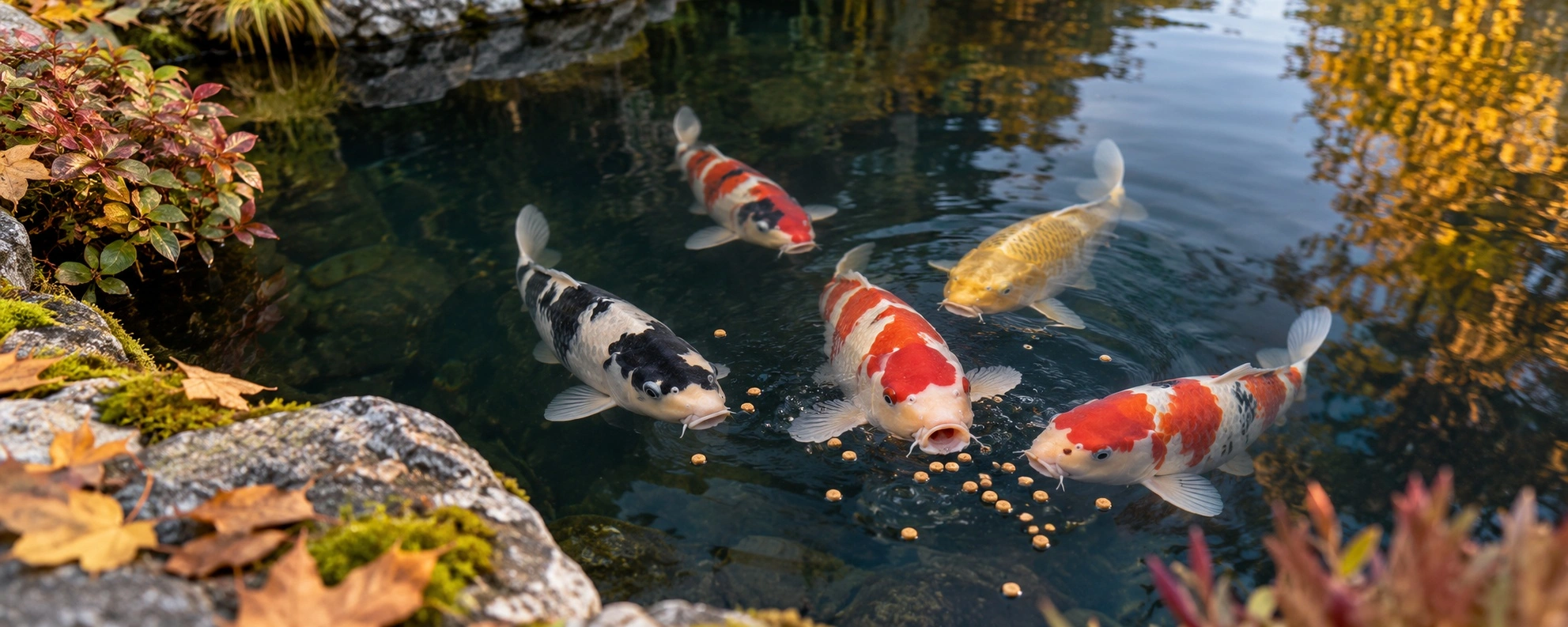
September does not automatically mean less food. If your koi are still active, the water temperature remains sufficiently high and the water parameters are stable, you can use the last warm weeks to condition the fish for winter. At the same time, this is a good opportunity to address any remaining weak points in the pond and filtration system.
September I already need to feed my koi less?
This is a question we hear again and again towards the end of the season. The days are getting shorter, the mornings are noticeably cooler and the first leaves are landing in the pond. Many pond owners automatically start reducing the amount of food as well.
In many cases, that is too early.
If your pond is still at 16, 17 or 18°C, the koi are actively coming to feed and the water parameters are good, there is no reason to put the fish on reduced rations simply because of the date.
Quite the opposite.
These weeks can still be used very effectively to condition your koi for winter. At some point, their metabolism will slow down significantly and they will eat very little or stop feeding altogether. The reserves they need for this period are built up beforehand.
The calendar does not feed koi. The decisive factor is the water temperature.
Summer food
We now have something that is often missing in spring stable biological system
In spring, we often talk about the filter first having to get back up to speed. After winter, temperatures are low, feeding starts gradually and the biological performance of the filter only begins to increase again as the load rises.
At the end of summer, the situation is exactly the opposite.
The pond has been running for months. The koi have been fed, they have been active and the biofilter has been working throughout the summer. In a well-functioning system, the filter biology has therefore adapted to the fish stock and the resulting load.
Ammonium, or ammonia depending on the pH, is converted into nitrite and then into nitrate. This nitrification process is one of the most important functions of the biological filter.
And this well-established phase is something we can still make use of.
That does not mean simply putting as much food as possible into the pond. But if the filter is performing well and the water parameters are stable, there is also no reason to reduce feeding unnecessarily early.
The filter is mature – but its capacity is not unlimited
This is an important point.
Saying «my filter worked perfectly all summer» does not mean that it can still process the same quantity of food in November as it did in August.
Filter biology is also affected by temperature. As the water temperature drops, nitrification slows down. At the same time, the metabolism of the koi changes, along with the way they digest and utilise their food.
In autumn, we therefore monitor not only the fish, but the entire system.
Ammonium or ammonia and nitrite should remain inconspicuous. KH, pH and oxygen levels should also continue to be checked.
With heavier feeding, the filter bacteria require oxygen and consume alkalinity during nitrification. If the water parameters begin to drift, it makes little difference that the koi still appear hungry.
At that point, feeding needs to be adjusted.
«It is October» is not a reason to stop feeding
We see this approach regularly as well.
As soon as October arrives, hardly any food is given, regardless of whether the water is still at 15 or 16°C.
That makes little sense.
A mild autumn can extend the season considerably. Larger and deeper ponds also respond much more slowly to cold nights than small systems.
That is why we measure the water temperature.
Not the afternoon air temperature. And not the weather app.
It may be 20°C during the day while the pond is already considerably cooler. Conversely, a large volume of water can retain heat for a surprisingly long time, even after several cold nights.
The in your pond gives you the better answer.
When should we reduce feeding?
As long as the water temperature remains above roughly 15°C, the koi are feeding actively and the system is stable, you can continue feeding sensibly.
Sensibly does not mean as much as possible.
The food should be eaten quickly and completely. If pellets remain uneaten, float around the pond for a long time or end up untouched in the skimmer, you have fed too much.
Several smaller portions are therefore better than one very large feed.
Once the water temperature remains consistently around 12–14°C, we reduce the amount significantly and start adapting the feeding regime to the colder season.
This is not a switch that suddenly has to be flipped at 13.9°C.
It is a gradual transition.
Also pay attention to the behaviour of your koi. Are they still coming to the food together? Is everything eaten immediately? Or are they becoming increasingly calm and spending more time in deeper areas of the pond?
The fish usually show us quite clearly when things begin to change.
Sinking food becomes useful as the water gets colder
As temperatures continue to fall, koi increasingly spend more time in deeper layers of water. At that point, a sinking food can make sense.
For example, we use .
The food sinks and therefore also gives calmer or less dominant koi a good opportunity to feed.
Below 12°C, however, the quantity of food should be clearly reduced and adapted individually to the activity of the fish.
If the water temperature drops further, a proper winter food can be introduced.
Our is a sinking food developed specifically for the colder season and can be fed at water temperatures below 10°C.
At these temperatures, the following applies even more strongly:
- Only feed if the koi are actually eating.
- A winter food does not mean you can feed the same quantity at 7°C as you did in September.
Winter food
Now is also the time to correct weak points in the pond
The season will probably have shown you quite clearly where your system works well and where there is room for improvement.
- Did the filter need to be cleaned unusually often?
- Was one of the bottom drains not pulling properly?
- Are there areas with a lot of sediment or sludge?
- Is aeration marginal?
- Or has the flow rate gradually decreased over the course of the season?
If so, now is a good time to take another look at these points.
As long as the pond is still biologically active, certain corrections are much easier to carry out than in the middle of winter.
What we would not recommend is an unnecessary complete cleaning of the biological filter stage.
Removing mechanical waste: yes
Scrubbing away the entire biofilm: no
We have built up this biology over the course of the season. Now we want to make use of it rather than destroy it without good reason.
Feeding is also the ideal time to observe your koi
Especially before winter, it is worth watching the fish more carefully during feeding.
- Are all the fish really coming to feed?
- Does one koi suddenly stay behind?
- Is one fish separating itself from the group?
- Is a koi clamping its fins or behaving unusually calmly?
Differences like these are often easiest to notice during feeding.
A koi that is already clearly declining in September or October should not simply be dismissed with «it is autumn».
If one individual fish stops eating while the rest of the stock actively comes to the food, it is worth taking a closer look.
We want to identify potential health problems before winter rather than discovering in spring that a koi has come through the cold season significantly weakened.
Do not forget the automatic feeder in autumn
If you use an automatic feeder, it should also be reviewed at this time of year.
In summer, feeding small portions throughout the day can work extremely well. The problem arises when the feeder is still dispensing exactly the same amount in October as it was six weeks earlier.
Check whether the quantity needs to be adjusted.
The automatic feeder does not know that your koi are less active today either.
The feeding quantity therefore needs to be reviewed regularly in autumn. When temperatures change quickly, adjustments may be necessary within just a few days.
Now is also the time to check your food stocks
The change of season is also a good opportunity to check how much koi food you still have in stock.
Will your current main food last for another few warm weeks? Do you already have a suitable sinking food or winter food available? And what are you likely to need when the new season starts next spring?
If you buy larger quantities, storage conditions also need to be taken into account.
Koi food should be stored in a dry, cool and dark place and kept well sealed.
A huge stock is of little benefit if the food is exposed to heat, moisture or air over a long period.
We therefore recommend planning ahead sensibly rather than simply storing as many bags as possible.
Do not ease off too early
Autumn is a transition period, and feeding should be treated in exactly the same way.
- Do not reduce feeding on 1 September simply because it is September.
- Do not stop feeding on 1 October simply because it is October.
- Do not continue feeding unchanged while the pond gets colder week after week.
As long as the koi remain active, the water parameters are good and the biofilter is processing the load properly, we can use the remaining warm weeks to condition the fish well for winter.
Once the water temperature settles around 12–14°C, we reduce the amount of food and gradually adapt the type of food.
When it becomes properly cold, we only feed small quantities of a suitable sinking winter food – and only if the koi are actually looking for food.
So do not look at the calendar first.
Look into your pond.
I am a Koi lover through and through. Starting with keeping fish and koi, my path led to koi breeding and the founding of koikichi.ch.


